zuvloop is a replacement for the built-in asyncio event loop.
Your code stays the same. The loop underneath gets faster. 🚀
The key features are:
Fast: Scheduling, timers, sockets, and DNS run in native code, driven by libuv - the same engine behind Node.js. Over 20x faster than asyncio at thread-safe scheduling. Compare it with uvloop and rloop in the benchmarks below.
Drop-in: One line to switch. Everything is standard asyncio — same Task objects, same protocols, same APIs.
Fully typed: Ships type hints for everything and passes strict mypy. Your editor will love it. ✨
Observable: Built-in OpenTelemetry instrumentation — slow-callback spans, loop metrics, an unhandled-exception counter. Zero cost until you turn it on.
Modern: Built for Python 3.14, including the new asyncio introspection tools (python -m asyncio ps, call graphs, and friends).
Performance
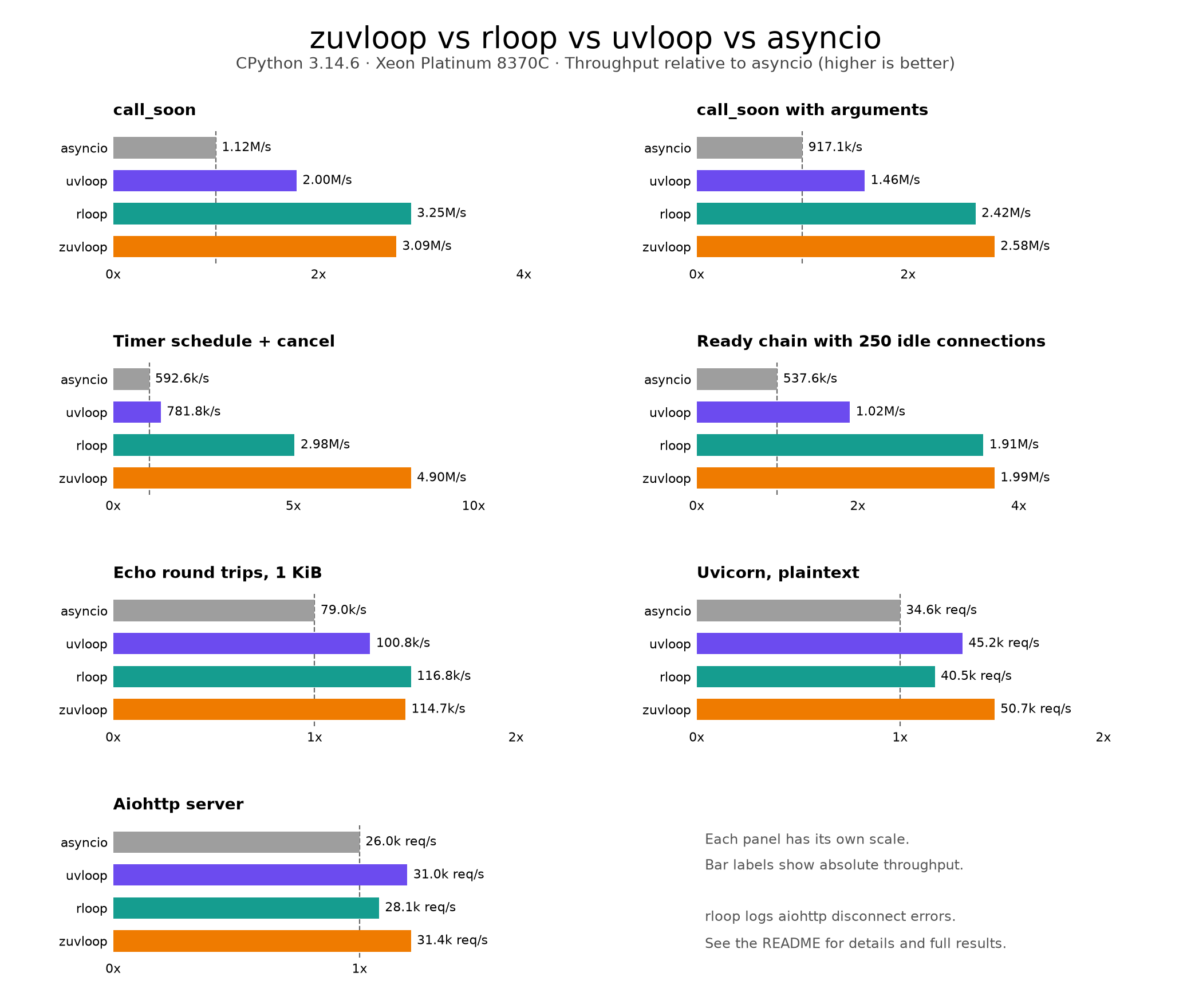
Throughput relative to stock asyncio (higher is better), measured with the suite in
benchmarks/ on an Azure Standard_E104is_v5 VM: an Intel Xeon Platinum 8370C with 104 vCPUs,
Ubuntu 24.04, CPython 3.14.6, and libuv 1.53.0. The comparison uses uvloop 0.22.1 and rloop 0.5.0.
Each result is the median of seven interleaved in-process runs or five interleaved HTTP runs. The
chart shows selected benchmarks, with a separate scale for each panel. Labels show absolute
throughput. See the .
The VM size is isolated: no other tenant shares its hardware, and nothing else ran during the
measurements. Check the recorded run-to-run variation before treating small differences as meaningful.
Benchmark
asyncio
uvloop
rloop
zuvloop
call_soon
1.12M/s
2.00M/s
3.25M/s
3.09M/s
call_soon with arguments
917.1k/s
1.46M/s
2.42M/s
2.58M/s
call_soon_threadsafe
199.3k/s
2.88M/s
6.36M/s
5.09M/s
timer schedule + cancel
592.6k/s
781.8k/s
2.98M/s
4.90M/s
completed timer rounds
450.7k/s
1.30M/s
2.04M/s
4.57M/s
prebuilt due timer batch
783.4k/s
1.79M/s
6.59M/s
6.73M/s
ready chain with 250 idle connections
537.6k/s
1.02M/s
1.91M/s
1.99M/s
bulk stream
3.8 GiB/s
4.2 GiB/s
5.4 GiB/s
5.0 GiB/s
echo round trips, 1 KiB
79.0k/s
100.8k/s
116.8k/s
114.7k/s
uvicorn, plaintext
34.6k req/s
45.2k req/s
40.5k req/s
50.7k req/s
uvicorn, 10 KiB body
32.6k req/s
44.1k req/s
36.5k req/s
47.7k req/s
aiohttp server
26.0k req/s
31.0k req/s
28.1k req/s
31.4k req/s
aiohttp client
6.4k req/s
8.3k req/s
8.5k req/s
8.7k req/s
getaddrinfo, numeric host
21.8k/s
732.6k/s
559.1k/s
807.0k/s
With rloop, the aiohttp server benchmark logs TypeError callback errors when the load generator
disconnects at its deadline. The throughput above includes this behavior.
The timer rows measure different work. Timer schedule + cancel isolates heap bookkeeping and handle cleanup without
firing callbacks. Completed timer rounds chain one zero-delay timer per event loop turn. The prebuilt due timer batch
measures heap draining and callback dispatch, with allocation and deallocation outside the timed section.
Curious how? The architecture docs explain the design:
argument storage inside handles (no tuple per callback), a native timer heap behind a single
uv_timer_t, per-turn vectored write batching, zero-copy reads, and a getaddrinfo fast path
for address literals.
Requirements
Python 3.12+
Standard CPython builds, and free-threaded builds on 3.14+
Linux, macOS or Windows
Prebuilt wheels for Linux x86-64/AArch64, macOS x86-64/arm64 and Windows AMD64/ARM64
Installation
$ pip install zuvloop
Source distributions install a pinned Zig 0.16 toolchain in their isolated build
environment. Direct native development commands require Zig 0.16 on PATH.
zuvloop emits plain OpenTelemetry. Its small runtime surface is opentelemetry-api plus
typing-extensions for the shipped type declarations — no SDK and nothing vendor-specific.
Providers can be configured before the loop starts or from inside
it — logfire.configure() in main() works: zuvloop checks at each run_forever() entry and
re-checks on its sampling interval (loop.metrics_interval, 10 seconds by default) while the
loop runs. Until a provider is installed the instruments are no-ops and slow-callback timing
stays off.
Anything that speaks OpenTelemetry can collect it. For example, with
Logfire:
That's all — there is no zuvloop-specific setup. Spans and counters are emitted
as events happen, and the loop gauges are sampled automatically while the loop
runs (published only once a real provider is installed; without one the
snapshot is dropped).
You get:
zuvloop.slow_callback spans include elapsed callback time measured by uv_hrtime()
in native code. The call graph is captured after the callback returns, so its last
await identifies the next suspension point, not necessarily the work that was slow.
thread.id identifies the loop thread. Set loop.slow_callback_cpu_time_enabled = True
to add cpu_time in seconds when the platform clock is available. The default is
False, avoiding a thread CPU clock read on every monitored callback. A low CPU/wall
ratio can reflect synchronous waiting or scheduling delays; it does not distinguish
them. GC CPU time is included in callback CPU time.
zuvloop.unhandled_exceptions counter, with the exception class in error.type. The exception
itself goes to the standard asyncio logger, not to a span.
Counters, a callback-duration histogram, and live loop gauges (loop_count, events,
idle_time_ns, ready, timers, watchers, ...).
And because zuvloop schedules real asyncio.Task objects, the Python 3.14 introspection tools
work unchanged:
Every pull request is held behind three stable aggregate gates. The first covers the in-repository
suite on Linux and macOS, the portable suite on Windows, plus musl runtime tests,
cross-compilation, ReleaseSafe builds and documentation. The second runs CPython conformance and
pinned upstream suites from aiohttp, uvicorn, AnyIO, websockets, aioquic, Tornado and HTTPX2 with
zuvloop swapped underneath. The third runs the native sanitizer build and a 500-cycle
resource-ownership soak.
The compatibility run also tests CPython 3.12.0, the newest 3.12 patch, 3.13.0, the newest 3.13 patch, 3.14.0, the newest 3.14 patch, and standard and free-threaded
3.15 builds, then exercises gRPC AsyncIO, asyncpg, Psycopg and redis-py against real local services.
The immutable commits and exact commands in .github/workflows/compatibility.yml are the source
of truth.
scripts/conformance.py runs CPython's EventLoopTestsMixin, SubprocessTestsMixin and
BaseSockTestsMixin against zuvloop, downloading the source of whichever interpreter is running
so the suite always matches it. Each test runs in its own process, so a hang is reported rather
than stopping the run. Three of the four skips are white-box tests of CPython's own internals -
two patch asyncio.base_events.socket, one counts calls to BaseEventLoop._run_once - which no
loop outside the standard library can satisfy.
The aiohttp compatibility run disables its optional blockbuster plugin because that plugin
exempts stdlib asyncio calls by source filename and therefore reports equivalent os.stat and
os.sendfile calls from any third-party loop. Its remaining strict expected failure is the
loop.time() difference below. One concurrent WebSocket-close test is skipped because it assumes
selector-loop ready/I/O ordering and fails intermittently on uvloop too; every other aiohttp test
remains enforced.
(For reference: uvloop cannot complete the aiohttp suite — it fails fifteen tests and then hangs.)
There is one intentional difference: patching loop.time() does not move the scheduler.
zuvloop keeps its timer heap in native code and reads the clock directly, so monkeypatching
time() — a trick some test suites use to fast-forward timeouts — changes what loop.time()
returns and nothing else. A loop that needs a controllable clock should schedule against one
explicitly.
One more deliberate divergence: handles
returned by call_soon implement the asyncio.Handle interface but are not instances of it:
the base class is 56 bytes of storage such a handle never writes, measured at 2% of call_soon,
which is the object the loop allocates more often than any other. call_later and call_at
do return real asyncio.TimerHandle instances, so they order and compare by deadline, and
call_soon_threadsafe returns a real asyncio.Handle, because 3.14 requires cancelling one
from another thread to block until a callback that has already started finishes. A call_soon
made from a thread other than the loop's is handled as call_soon_threadsafe, so it returns
that handle too.
Development
$ uv venv --python 3.14
$ uv pip install -e . --group dev
$ uv run pytest
$ uv run mypy
$ uv run ruff check
$ uv run ruff format --check
$ ./scripts/check-zig  # requires ZLint 0.9.1 on PATH
$ uv run --group bench python benchmarks/run.py
The extension is rebuilt by the hatch-ziglang build hook on every install. To rebuild in place:
$ python scripts/build.py
vendor/libuv is an unmodified upstream release tarball; see vendor/README.md. Update it with
./vendor/update-libuv.sh <version> <sha256>.
License
This project is licensed under the terms of the MIT license.
Alternatives
Use instead of zuvloop: tools that do the same job, closest first.